
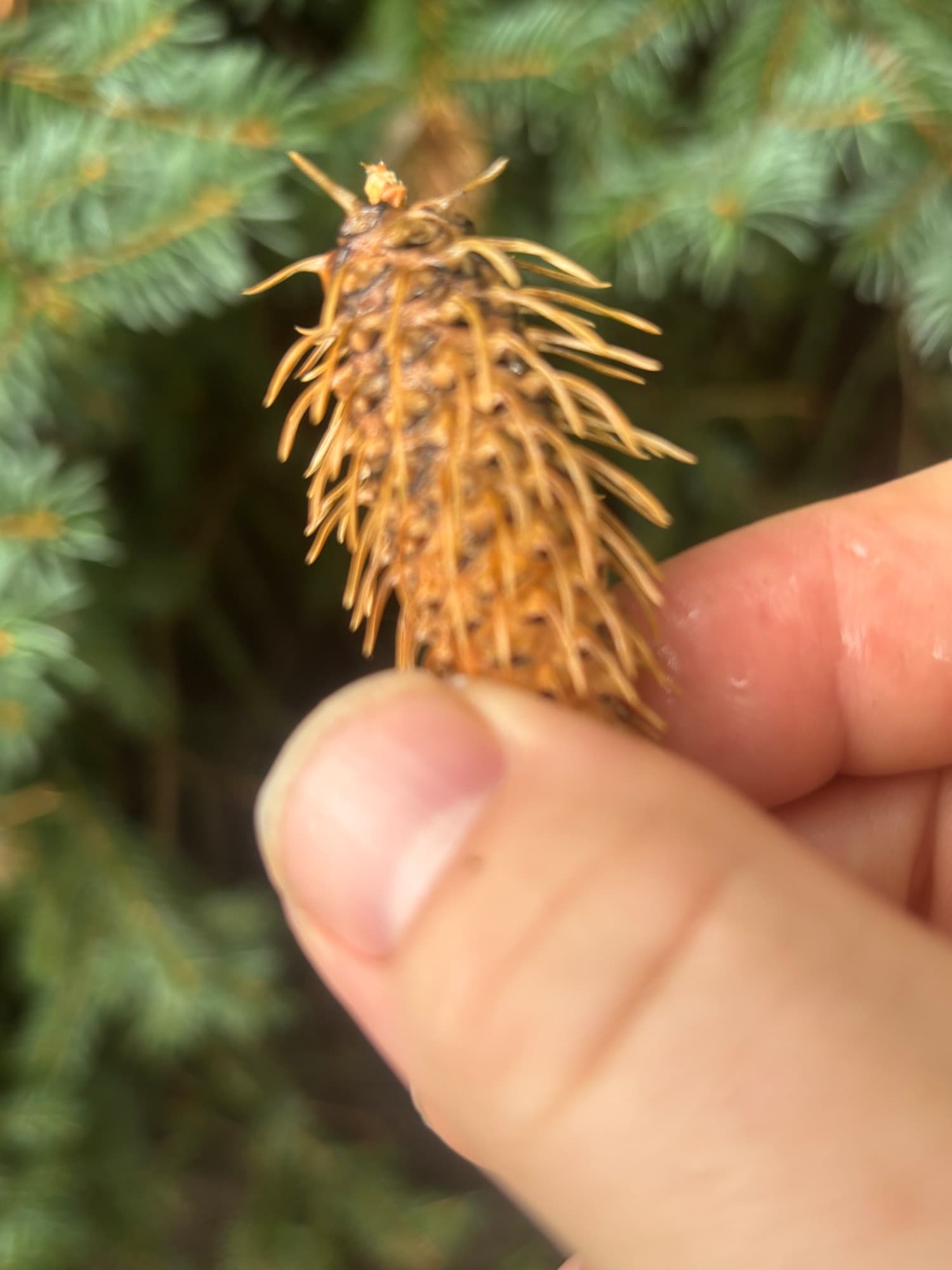
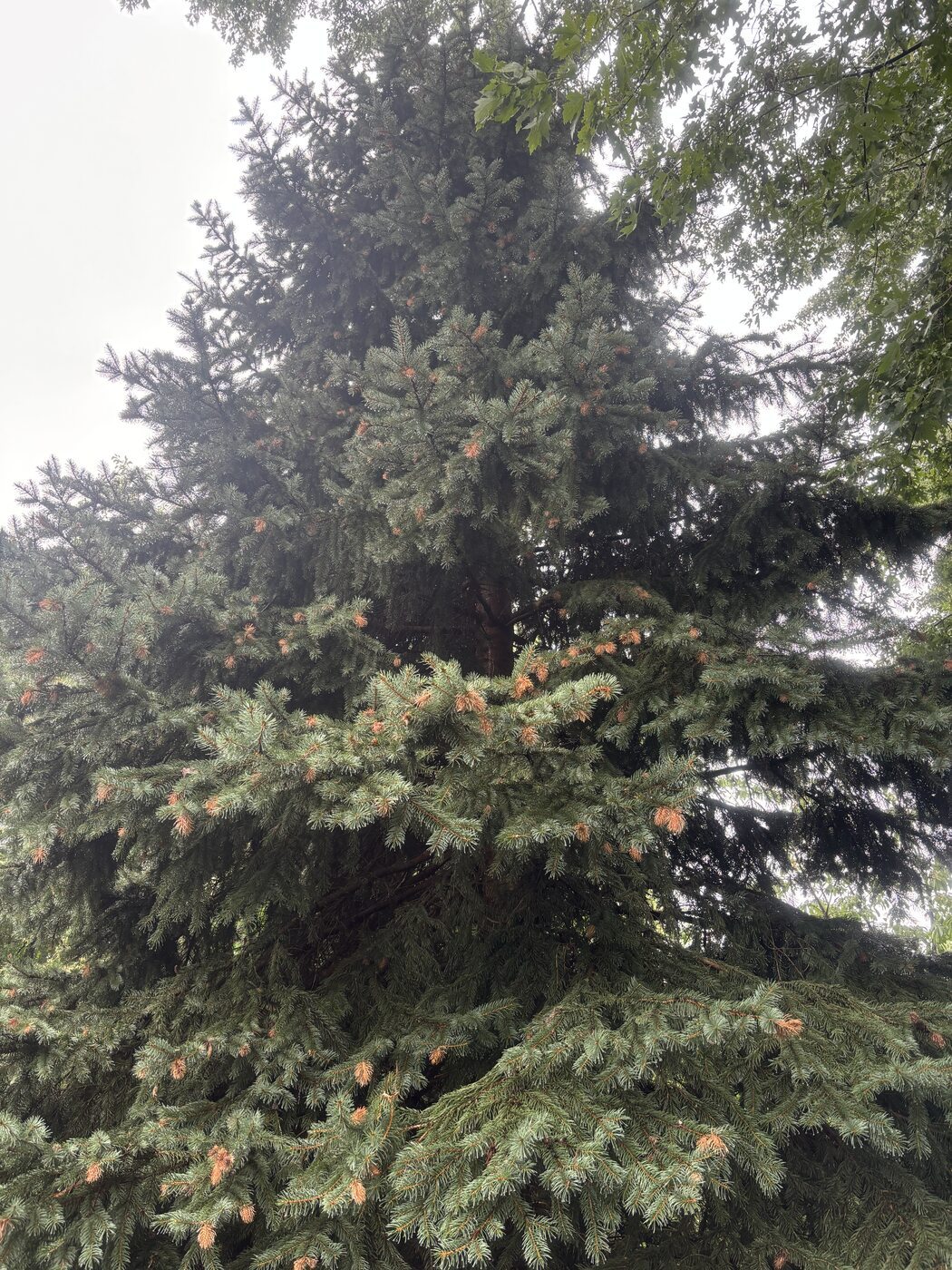
Someone sent a photo of a 25-year Colorado blue spruce with droopy, brownish branch tips. The internet — and at least one phone AI — called it tip blight. Sirococcus. Phomopsis. Fungal.
I went and looked at it.
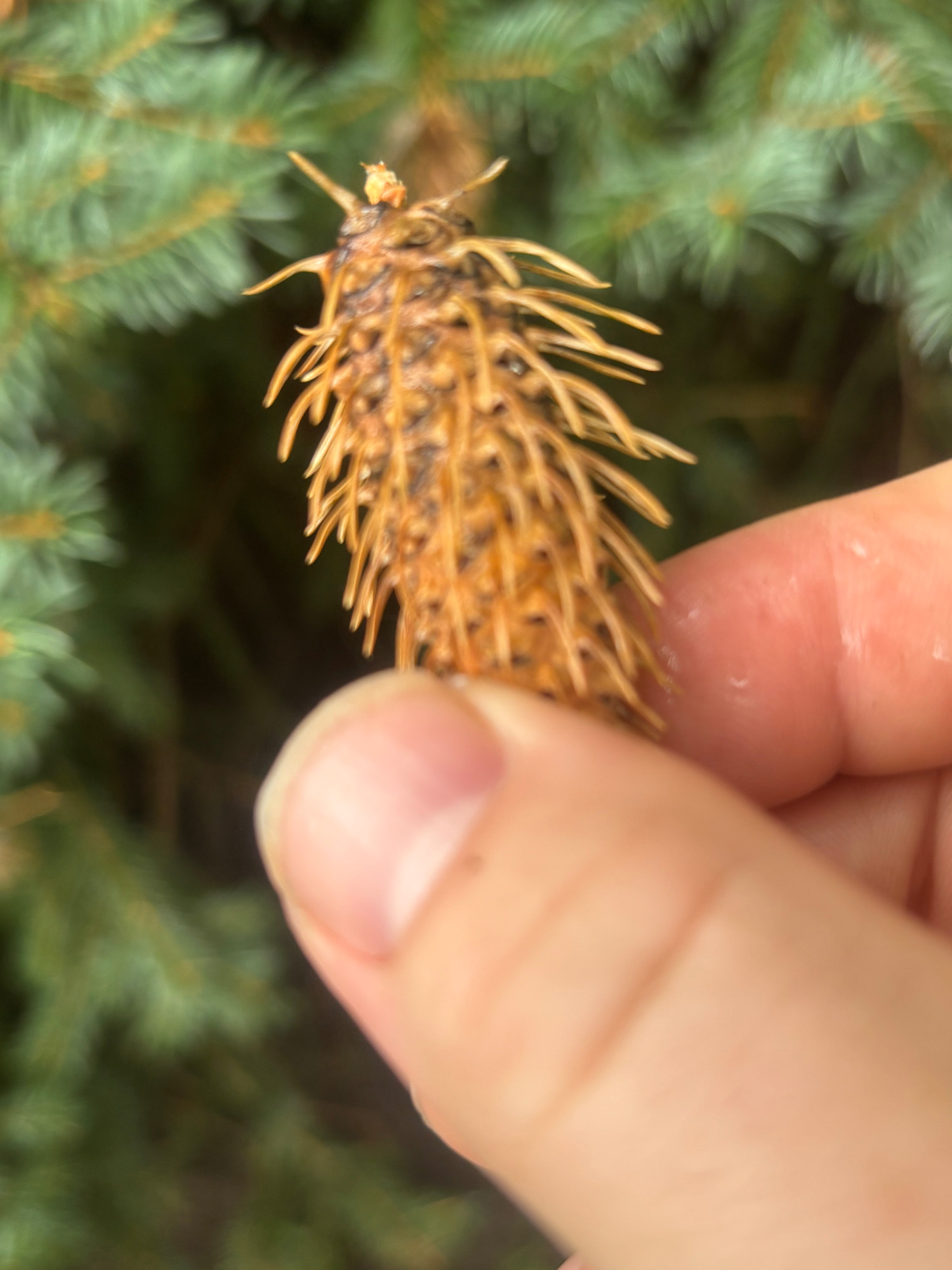
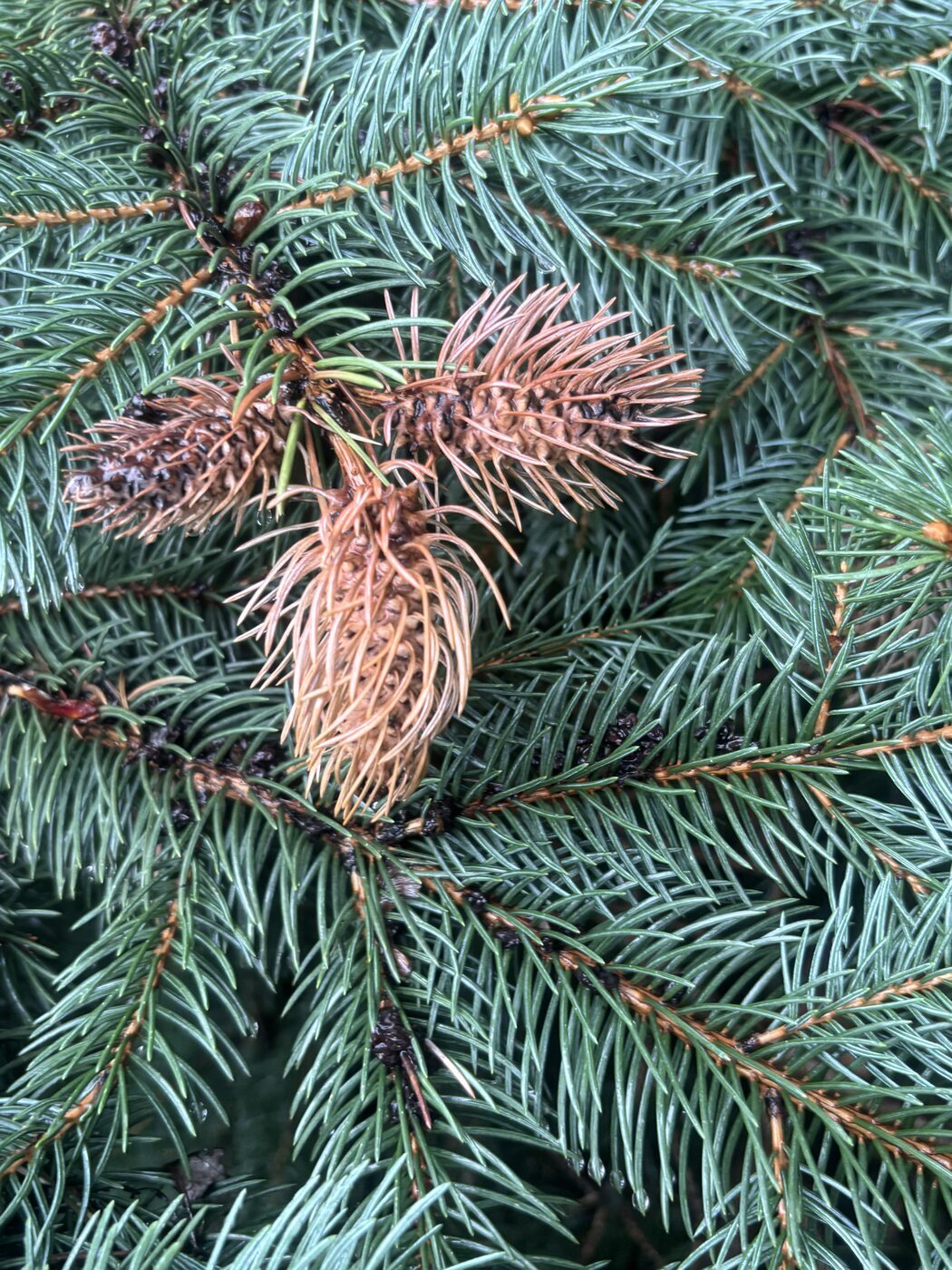
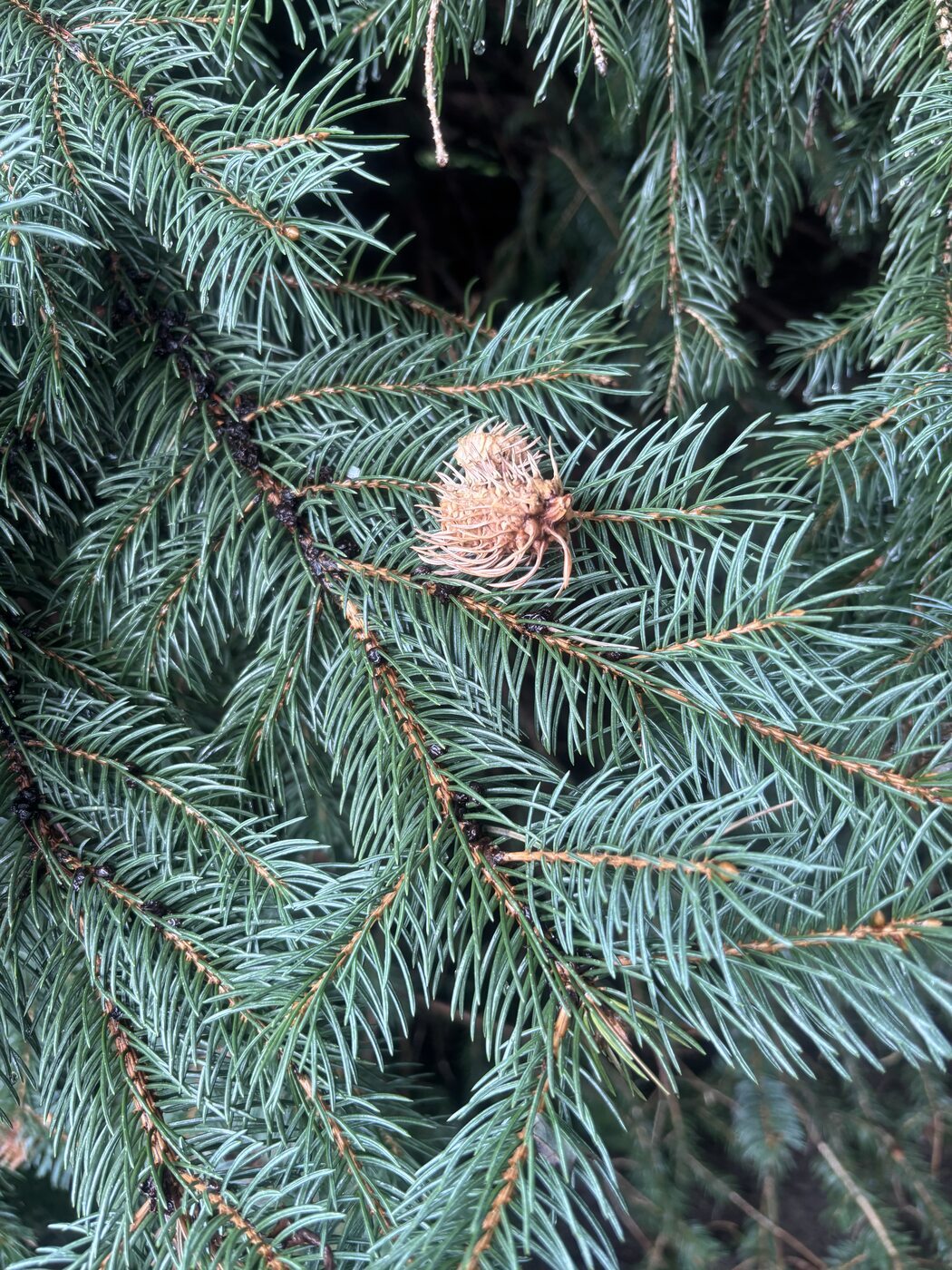
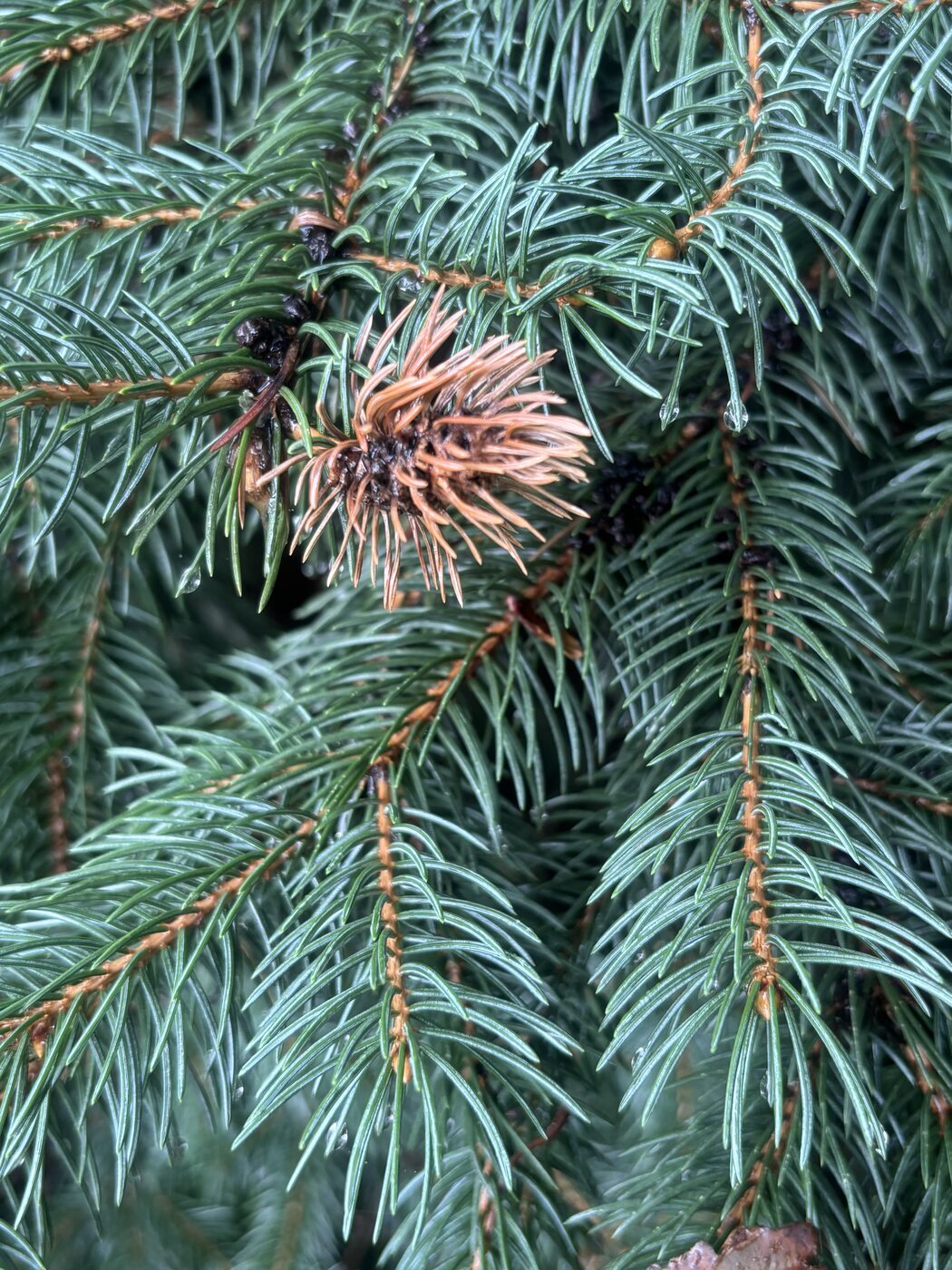
It was not blight. The brown tips were pineapple-shaped galls sitting on the ends of this year's shoots. That is Cooley spruce gall adelgid — Adelges cooleyi. I had not clocked this one on a Durham lot before. Worth putting on the page, because once you have seen a real one you stop guessing blight from a driveway photo.
What You Are Actually Looking At
An adelgid is a tiny sap-feeding insect related to aphids. The one that matters on a blue spruce here is Adelges cooleyi. The insect itself is easy to miss. The gall is not.
In spring, newly hatched nymphs feed on the expanding shoot. The tree answers by swelling the new growth into a green, elongate, pineapple- or cucumber-shaped gall that encloses the nymphs. There is no healthy shoot beyond that gall — the tip is the gall. By late summer the gall turns brown, dries, and cracks open. Winged adults crawl out. The brown "cone" stays on the tree, often for years, and the tip of that shoot is dead.
That is the droopy brown tip people photograph in September.
On Colorado blue spruce (Picea pungens) — the common landscape blue spruce in Ajax, Pickering, Whitby, and Brooklin — this is the usual host. Engelmann, Sitka, and Oriental spruce can take it too.
On Douglas-fir (Pseudotsuga menziesii) there is no gall. You get woolly white nymphs on the needles, yellowing, and twisted foliage. Same insect, different costume. If you planted a blue spruce next to a Douglas-fir, you built both halves of the cycle on one lot.
The adelgid can finish its life on spruce alone. It does not need the Douglas-fir. The pair just makes it worse.
Cooley vs Eastern — Do Not Mix Them Up
There are two common spruce-gall adelgids. People use the names interchangeably and then prune or spray the wrong window.
Cooley spruce gall adelgid (Adelges cooleyi)
- Host: Colorado blue spruce, plus a few other spruces; alternate host Douglas-fir
- Gall: elongate pineapple / cucumber, at the tip of the current-year shoot
- No growth past the gall
Eastern spruce gall adelgid (Adelges abietis)
- Host: white spruce and Norway spruce
- Gall: pineapple-shaped, at the base of the new shoot, with green growth continuing beyond it
If the brown lump is on the end of a blue spruce tip, it is Cooley. If it is sitting at the base of new growth on a white or Norway spruce, you are looking at Eastern. Same family of problem. Different tree, different spot on the shoot.
The Cycle, Without the Textbook
Overwintering immature females sit in bark crevices and at the bases of buds. In spring they mature into stem mothers and lay eggs. Nymphs move onto the new flush, feed, and get boxed into the gall. Late summer the gall opens. Adults leave. Some stay on spruce. Some go looking for Douglas-fir.
By the time the gall is brown and obvious — which is when I get the photo — the insects that built it are already gone. Cutting that brown gall off does not reduce next year's population. It just makes the tree look cleaner. Spraying that brown gall does nothing. The chemistry cannot reach an insect that has left.
The spray window, if you are going to use one at all, is aimed at the overwintering females, not the gall:
- Mid-September through early October — they are settling at the bud bases right now
- Or just before budbreak in spring, before the stem mothers finish laying
Once the new shoot has swollen into a gall, you missed it for the year.
What I Will and Will Not Do About It
Colorado State and the Canadian agroforestry notes say the same thing I say on the lawn: control is rarely needed to protect the tree. Heavy infestations can distort young spruce and kill infested tips. A 25-year blue spruce with a scatter of brown pineapples is ugly, not dying. Next year's flush will grow past a lot of it.
Prune green galls in June and July if you can reach them, before they open. Bag them. That is real population control on a small tree. Brown galls in September are cosmetics.
Do not fertilize a tree that is already loaded. Soft, lush growth is what the adelgid wants.
Do not pair a new blue spruce with a Douglas-fir on a tight lot. Right tree, right place includes that pairing.
Do not buy a September spray for a brown gall. Under Ontario Regulation 63/09, a conventional insecticide on a landscape tree needs a written opinion from someone with the right credentials — ISA Certified Arborist, registered professional forester, or qualified utility arborist — that the treatment is necessary for the health of that tree. We have to use integrated pest management, and we have to refuse when it is not necessary. A backyard blue spruce with last spring's empty galls is almost never that case.
If the tree is a specimen, the infestation is heavy year after year, and we are targeting the overwintering females in the actual window — mid-September to early October, or pre-budbreak — that is a different conversation. It is still not "spray the brown pineapples."
Tip blight is a different disease. If the needles are browning from the tips back without a woody pineapple at the shoot end, we are in fungus territory and I will say so. That is why I went to look instead of answering the AI from the email.
When It Is Worth a Visit
Come find me if:
- The brown tips are all over a young blue spruce, not a handful on a mature tree
- You also have a Douglas-fir on the same lot and both look rough
- You cannot tell whether you are looking at a gall, a cone, or actual tip blight
- You are about to plant a blue spruce and you want the pairing done once
That is tree health care, not a product. A photo of the shoot tip — the whole tip, not one needle — is often enough to tell Cooley from blight before we roll a truck.
Droopy brown tips on a blue spruce in Ajax, Whitby, Pickering, Brooklin, or anywhere in Durham Region? Send a photo or book a free assessment — I will tell you whether it is Cooley spruce gall adelgid, and whether the honest answer is prune, wait, or leave it alone.