
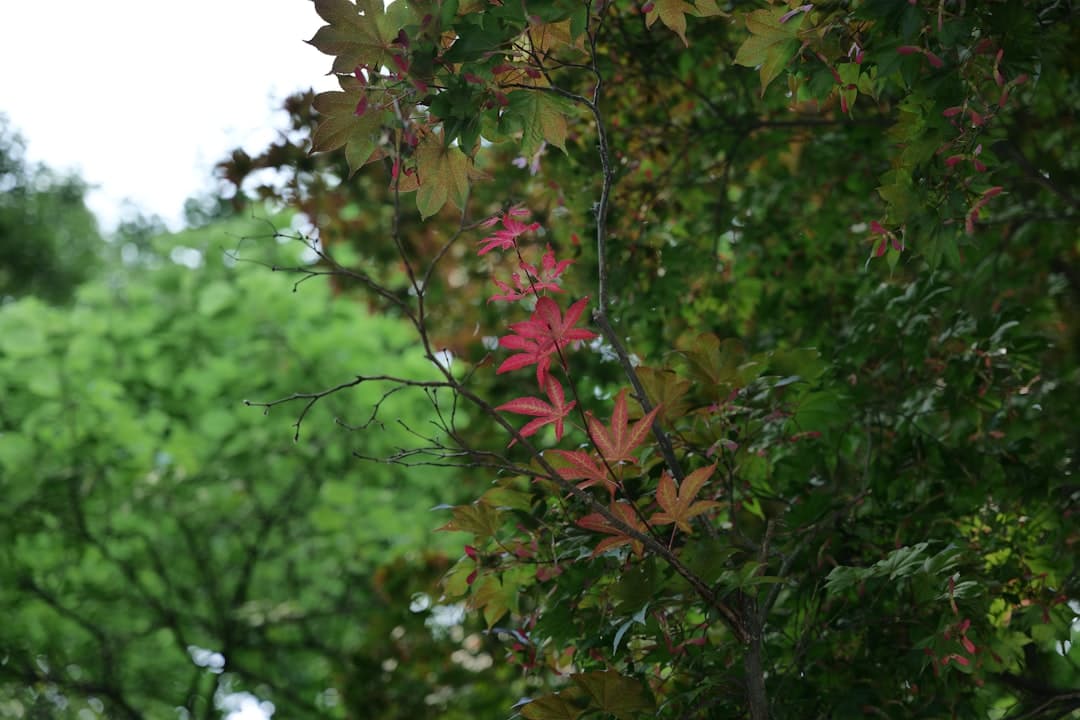
It's the third week of August and one of your maples has decided it's October.
Not the whole tree. That's the part that matters. One limb, or one side of the crown, has gone red and papery while the rest of the canopy is still green and doing its job. Every year around now I get calls that start with some version of "is my maple just confused?"
It isn't confused. A tree that colours up early is a tree that has decided to shut down part of itself, and it does that for a reason. Sometimes the reason is boring — it's been a dry summer and the tree is triaging. Sometimes the reason is Verticillium, and the difference matters, because one of those situations changes what you should plant in that spot for the next couple of decades.
Start With the Asymmetry
Here's the single most useful thing a homeowner can notice, and you don't need any equipment to do it.
Walk all the way around the tree.
If the early colour and the thinning are spread evenly through the whole canopy, you're most likely looking at general stress — drought, heat, compacted soil, a root system that never established properly. If the decline is lopsided — one flank failing while the other flank looks healthy — you're looking at a plumbing problem.
That asymmetry is the signature of a vascular disease. Vascular diseases move up through the tree's water-conducting tissue, and they don't colonize it evenly, so the branches fed by the blocked vessels fail while their neighbours carry on. It's the same logic that makes Dutch elm disease and Emerald Ash Borer so distinctive once you know what you're looking at.
Verticillium is the most common vascular wilt we see on maples in Durham Region.
What Verticillium Actually Is
Verticillium wilt is caused by soil-borne fungi — usually Verticillium dahliae, sometimes V. albo-atrum. The important word is soil-borne.
This is not a pathogen that blows in on the wind and lands on a leaf. It lives in the ground. It enters through the fine roots, often through the ordinary small wounds that roots pick up as they grow, and then it moves upward inside the xylem — the straw-like tissue that carries water from the roots to the leaves. As it colonizes those vessels, the tree responds by walling them off, and the combination of fungal growth and the tree's own defensive plugging chokes off water movement.
The leaves at the end of that plumbing get cut off from their water supply. They wilt, scorch, colour early, and drop. From the outside it looks like drought damage on one section of an otherwise well-watered tree, which is exactly what it is — localized drought, caused from the inside.
Maples are the classic host. Norway and Japanese maples are hit most often in this region, largely because they're the most heavily planted susceptible species on residential lots. Ash, catalpa, elm, linden, redbud, smoketree, and magnolia are also susceptible, and so are a lot of common landscape shrubs — lilac, viburnum, dogwood, spirea, and barberry among them.
The Sapwood Test, and Its Big Limitation
The classic confirmation is vascular staining. Cut into or peel back the bark of a symptomatic, still-living branch and look at the sapwood underneath. Verticillium infection typically leaves a greenish-black streak running with the grain in maples, and a browner stain in other species. In cross-section it shows up as arcs or partial rings rather than a solid discolouration.
When you find it, it's strong evidence. But there are two traps here, and both of them catch people:
Trap one: the stain can be a long way from the symptoms. The staining may sit several feet below the branch that's actually wilting. If you cut one twig at the tip of a dying limb, find clean wood, and conclude it's fine, you may simply have cut in the wrong place. You often have to work back toward the trunk, taking small looks as you go.
Trap two: absence proves nothing. The staining varies by species, by how far the infection has progressed, and by branch size, and sometimes it isn't visible at all — especially in young wood or early infections. No stain does not mean no Verticillium.
And it runs the other way too. Discoloured sapwood has a long list of causes: decay fungi, old wounds, winter injury, general stress. Ontario's own nursery pathologists have written about submitting suspicious stained maple samples and having every one come back negative for Verticillium. Staining is a clue, not a verdict.
Getting an Actual Answer
If the diagnosis is going to change a real decision — whether you keep the tree, what you plant next, whether you spend money on care — get it confirmed in a lab rather than guessing.
In Canada, the University of Guelph's Agriculture and Food Laboratory runs DNA-based testing that covers Verticillium species, with results in a handful of business days. What they need is a good sample, and this is where most submissions fall down:
- A living, symptomatic branch — not one that died last season and dried out
- Roughly thumb-thick or better, about 8 to 12 inches long
- Taken from the zone where healthy tissue meets failing tissue, not from the dead tip
- Bagged and submitted promptly, not left in a hot truck for a week
Verticillium is slow compared to something like Dutch elm disease. There is time to take a proper sample, wait for the result, and then decide — you are not in a race.
Treatment: The Honest Version
There is no fungicide that cures Verticillium wilt. Not a homeowner product, not a professional product, not an injection. The pathogen is inside the vascular system and in the surrounding soil, and nothing available in Canada reaches it.
I want to be blunt about this, because it's the kind of gap where money gets wasted. Under Ontario Regulation 63/09, a licensed applicator can only use a conventional pesticide on your tree if a professional like me first signs a written opinion saying the treatment is necessary to maintain that tree's health — and we're required to apply integrated pest management principles and refuse to write one when the treatment isn't justified. For Verticillium there's nothing to prescribe, so there's nothing to sign. If somebody offers to spray or inject your maple to cure Verticillium wilt, that alone tells you something about who you're dealing with.
What genuinely helps is reducing everything else the tree is fighting:
Water it properly. Deep, infrequent watering through dry spells. The tree's water transport is already compromised, so anything that raises demand or lowers supply makes the visible symptoms worse.
Go easy on nitrogen. Do not push a stressed, infected tree into a flush of soft new growth it can't supply with water. If the soil genuinely needs correcting, root zone work based on what the soil actually lacks is the right approach — heavy nitrogen fertilizer is not.
Prune out what's failed. Take symptomatic limbs back to their junction with the next-largest healthy branch. This won't cure anything, but it removes the dead weight, reduces hazard, and often leaves a presentable tree. Structural pruning done properly buys you years.
Then be honest about the specimen. Verticillium shows up in two patterns. The chronic form lets a tree limp along for years — losing a limb here and there, still providing shade, still worth keeping. The acute form takes a tree down in a season or two. If pruning out the affected wood would leave a lopsided wreck against your house, removal is the reasonable answer, and I'd rather tell you that than sell you a care plan for a tree I don't believe in.
The Two Mistakes That Come After
These are the ones that cost people a second tree, and almost nobody warns them.
Don't mulch with the chips. If we take down a tree that died of Verticillium, those wood chips are not safe mulch for your garden beds. Research indicates the fungus stays viable in chipped wood for a considerable time, and spreading it around your ornamentals is the definition of a self-inflicted wound. When we grind a stump or chip out a suspected Verticillium tree, that material goes off site. Be equally careful with mystery mulch of unknown origin from a big-box store.
Don't replant the same thing in the same hole. The soil stays infested for years — realistically, longer than you'll be thinking about it. Putting a new Norway maple where the old Norway maple died of Verticillium is putting a susceptible host into a loaded gun.
If you're replacing a Verticillium-killed tree, plant something that isn't on the menu. All the conifers — pine, spruce, fir, cedar, larch, yew, juniper — are effectively immune. Among the deciduous options, birch, beech, ginkgo, hackberry, hawthorn, hickory, honeylocust, hophornbeam, katsura, mountain ash, pear, sweetgum, sycamore, walnut, willow, and the white and bur oaks are all considered resistant. Resistant is not the same as immune, and it varies with cultivar and with which strain is in your soil, but it's a very different bet than replanting a maple.
That's a conversation worth having before the new tree goes in the ground, not after. Our tree planting recommendations for a site with a Verticillium history look nothing like our recommendations for a clean site.
What To Do This Week
If a maple on your property is colouring up early, do the walk-around and note whether it's lopsided or even. Take a photo of the whole tree from a distance — not a close-up of one leaf, the whole tree — because the pattern of decline tells us more than any single leaf ever will.
Early colour on one side of a maple in August is worth a look. It might be a dry summer catching up with a stressed tree, in which case the fix is water and patience. It might be anthracnose or tar spot defoliating the tree early, which looks alarming and is mostly cosmetic. Or it might be Verticillium, in which case what you do next — and especially what you plant next — genuinely matters.
Those three situations look similar from the driveway and call for completely different responses. That's the whole argument for diagnosing before prescribing.
Seeing early colour or one-sided dieback on a maple in Ajax, Whitby, Pickering, or anywhere in Durham Region? Book a free assessment and we'll tell you what you're actually dealing with — including when the answer is "nothing, water it and relax."