
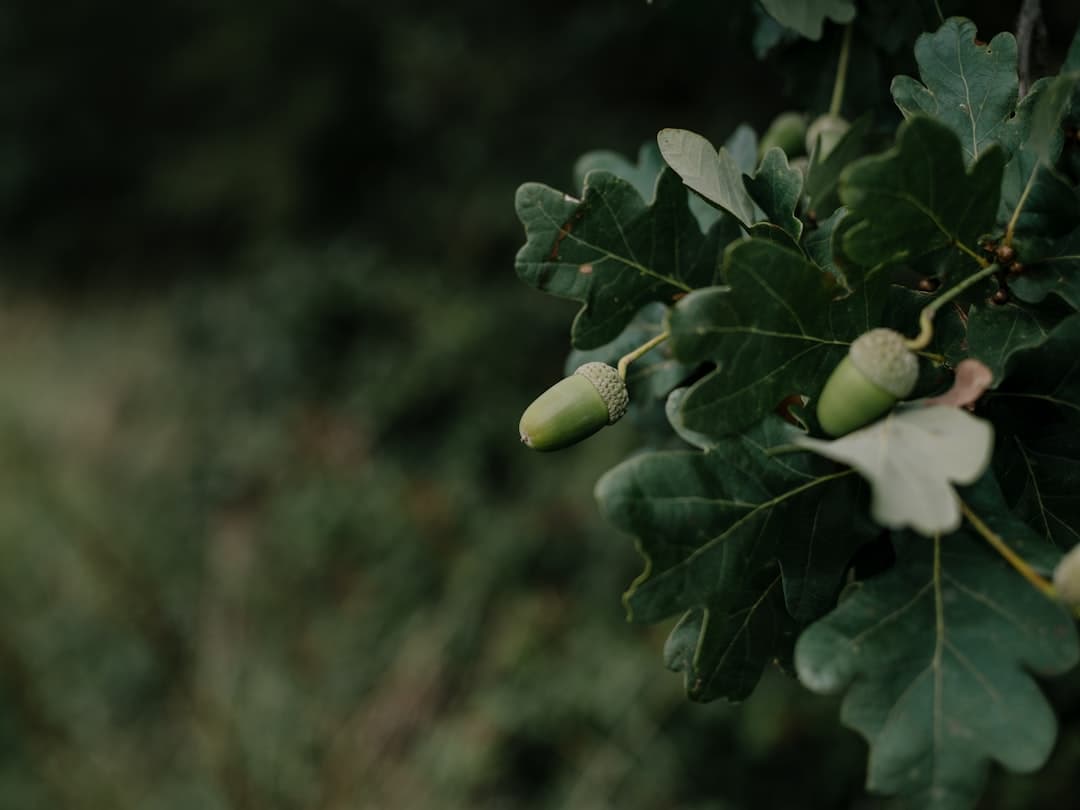
Late August is when oaks look their worst, and it's when I get asked the same question in a dozen different ways: why does my oak look sick?
Somebody has usually read about oak wilt before they call. It's a genuinely frightening disease with a genuinely frightening reputation, and it did arrive in Ontario in 2023. So let me put the most useful sentence at the top:
Oak wilt has never been confirmed in Durham Region, and your sick oak is very probably something else entirely.
I could get more work out of you by being vaguer than that. But panic isn't a diagnosis, and there's a much better use for the next ten minutes: learning what oak wilt actually looks like, learning what your oak probably has instead, and learning the one free habit that keeps the disease out of your yard if it ever does get close.
Where Oak Wilt Actually Is
Oak wilt is caused by the fungus Bretziella fagacearum — you'll still see it written under its old name, Ceratocystis fagacearum, in older references. It has been a major forest problem in the United States since the 1940s and is now present in roughly two dozen states.
It was confirmed in Canada for the first time in 2023, at three sites, all in Ontario:
- The City of Niagara Falls — the first Canadian detection
- The Township of Springwater, near Barrie
- The Town of Niagara-on-the-Lake
Since then, the Canadian Food Inspection Agency has been running eradication and surveillance at those locations, and here's the part that rarely makes the news: there have been no new detections since 2023. The CFIA's 2025 survey covered 129 sites nationally, including 57 in Ontario and delimitation surveys around all three original sites, and oak wilt was not detected anywhere. They also assessed more than 100 public reports.
That's a containment program working, and it's genuinely good news. The honest caveat, which the Province of Ontario states plainly, is that the disease may be present in parts of Southern Ontario where it hasn't been found yet. Surveillance is not omniscience. But there is no detection anywhere near Ajax, Whitby, Pickering, or Scarborough, and nothing in Durham Region.
What Oak Wilt Actually Looks Like
Worth knowing properly, because the details are quite specific and they're what separates a real report from a false alarm.
Speed is the headline. This is not a slow decline. A red oak can go from healthy to dead in two to twelve months. If your oak has been gradually thinning for four years, that history alone argues strongly against oak wilt.
The symptoms, in the order they appear:
- Wilting and discolouration that starts at the top of the tree and works down
- On individual leaves, colour change that begins at the leaf tip and moves inward toward the base — this pattern is one of the more distinctive features
- Premature leaf drop in mid to late summer, often while the leaves are still partly green
- A black stain in the sapwood beneath the bark
- White, grey, or black fungal mats just under the bark, which can give off a distinctly fruity, fermented smell
- Cracks in the bark on the trunk or large limbs, pushed open from underneath as those mats expand
Not all oaks are equal here. The red oak group — red, black, and pin oak — is most susceptible and dies fastest. The white oak group, including white and bur oak, tends to resist longer and decline more slowly.
It spreads two ways. Sap beetles are drawn to the fruity fungal mats, pick up spores, and carry them to fresh wounds on healthy oaks. And where oaks grow close together, it moves directly through connected root systems from tree to tree — which is why the CFIA's response includes physically severing root connections around an infected tree, and why it can persist in the roots after the tree above is dead.
So What Does Your Oak Actually Have?
Here's the differential I'm genuinely working through when I look at a struggling oak in Durham Region.
Oak decline — the most likely answer by a wide margin
Oak decline isn't one pathogen. It's a complex: a tree weakened by cumulative stress, then finished off by native organisms that couldn't have touched it when it was healthy.
The predisposing stresses are the familiar list — drought over consecutive years, advancing age, soil compaction, root severance from construction or a new driveway, poor rooting conditions, repeated heavy defoliation. Then two native opportunists move in:
- Two-lined chestnut borer (Agrilus bilineatus) — a native beetle in the same genus as the Emerald Ash Borer. Its larvae tunnel through the inner bark and cambium, and it typically attacks the upper crown first, working downward over two or three years. Because it's an Agrilus, it leaves similar D-shaped exit holes, which is a real source of confusion.
- Armillaria root rot (often Armillaria gallica) — a fungus that lives harmlessly on dead wood in the soil until a tree's defenses drop, then colonizes living roots and girdles them. Look for honey-coloured mushrooms clustered at the base in fall, and black, string-like rhizomorphs under the bark at the root flare.
This isn't a theoretical concern for Ontario. In 2002, the Town of Oakville faced significant oak mortality in Iroquois Shoreline Woods Park, and the investigation identified oak decline — driven by drought and defoliation, with two-lined chestnut borer and Armillaria as the secondary agents — as the cause. It's the same lakeshore climate we work in.
The tell is the timeline. Oak decline takes two to five years and progresses through the crown gradually. Oak wilt takes months. If you've been watching your oak get slowly worse since 2023, you're looking at decline, and the good news is that decline responds to the stress side of the equation — water, root zone care, removing whatever is compacting or severing the roots.
The cosmetic look-alikes
Plenty of oaks look rough in August for reasons that don't matter much:
- Anthracnose and other leaf spots — irregular papery brown lesions, worst on lower interior branches. Covered in detail in our leaf spot guide
- Powdery mildew — white dusty coating on the leaf surface, common on oaks in late summer, and almost never worth treating
- Galls and oak leaf blister — bumps, lumps, and puckered patches from tiny wasps or mites. Alarming, harmless
- Leaf scorch — uniform browning from the leaf margins inward with no discrete spots, which is a water problem, not a disease
The structural problems that masquerade as disease
And then the ones that have nothing to do with pathogens at all: girdling roots strangling the trunk at the flare, soil compaction from years of parking or foot traffic, grade changes that buried the root collar, or root loss from a nearby excavation two summers ago. These produce thin, unthrifty crowns that look like disease and respond to none of the treatments people try.
The One Rule Worth Adopting Regardless
Even with no oak wilt in Durham Region, adopt this, because it costs nothing:
Do not prune your oaks between April and November.
That's the CFIA's standing guidance, and the reasoning is direct. Sap beetles carrying oak wilt spores are attracted to fresh wounds during the growing season, and a pruning cut is a fresh wound with an open vascular system. Cut an oak in July and you've built the entry point the disease needs. Cut it in January, when the beetles are inactive and the tree is dormant, and that pathway is closed.
Prune oaks in the dormant season. Winter only. Whether or not oak wilt is in your neighbourhood, this is simply how oaks should be handled, and it's why we schedule oak pruning for winter as a matter of course rather than fitting it in whenever the calendar has room.
The obvious exception is genuine hazard. If a storm has left a broken limb hanging over your driveway in July, that comes down now — safety outranks disease risk, and we'll treat the wound appropriately. But elective, cosmetic, "while you're here" oak pruning in summer is a bad trade.
And don't move firewood. This is the other rule, and it's the mechanism behind most long-distance jumps of pests like this. Oak wilt, EAB, and a long list of others travel in cut wood. Buy firewood where you'll burn it. Don't bring a trunkful up from Niagara to a cottage, and don't haul your own wood to a campsite.
If You Genuinely Suspect It
If an oak on your property has wilted from the top down over a matter of weeks, dropped partly green leaves in mid-summer, and shows bark cracks or a fruity smell beneath the bark — that combination is worth escalating, and speed matters.
Report suspected oak wilt to the CFIA. Email cfia.surveillance-surveillance.acia@inspection.gc.ca or contact your local CFIA office. Regulatory confirmation happens only at the CFIA's Plant Pathology Laboratory — no private lab result counts for regulatory purposes, and no arborist including me can officially confirm it. If it is confirmed, the CFIA takes over: they may issue a Notice of Prohibition of Movement or a Notice to Dispose, direct removal with stump grinding, require the wood be chipped, burned, or buried, sever root connections to neighbouring oaks, and monitor a radius around the site.
What we can do is the practical part: assess the tree properly, rule in or out the far more likely causes, take a proper sample if it's warranted, and help you through the process if it turns out you've found something that matters. A hundred-plus public reports a year get assessed nationally and essentially all of them turn out to be something else — but the program only works because people report.
What To Do This Week
If your oak looks rough, gather three things before anybody starts guessing:
- A photo of the whole tree from far enough back to see the entire crown. The pattern of decline tells us more than a close-up of one leaf ever will.
- The timeline. Has this happened over weeks, or over years? This single question separates the frightening possibility from the likely one.
- A look at the base. Mushrooms at the root flare, a trunk that goes straight into the ground with no visible flare, or soil piled against the bark are all findings that point away from oak wilt and toward something you can actually fix.
Then get it looked at properly. An oak that's been declining for three summers isn't an emergency, but it is a tree telling you something about its roots — and that's a problem with real solutions, which is a much better position than the one you were worried about.
That's what a tree health care assessment is for: not confirming the scariest thing you read online, but finding out what's actually true so the money you spend goes somewhere useful.
Got an oak you're worried about in Ajax, Whitby, Pickering, or anywhere in Durham Region? Book a free assessment. We'll give you the real answer — including, most of the time, that it isn't oak wilt.